
Blog
December 12, 2025
Jim WagnerWhy Administrative Work Is Ground Zero for AI Transformation
Essay 2 of 3: AI Planning for 2026
Too often, technology feels like “innovation in search of a problem.” We see hype cycles for tools that don’t quite match the reality of our daily work.
This time is different.
Generative AI’s strongest capabilities—synthesizing documents, reconciling data, managing structured coordination—match precisely to the administrative work that dominates clinical operations. The fit is immediate.
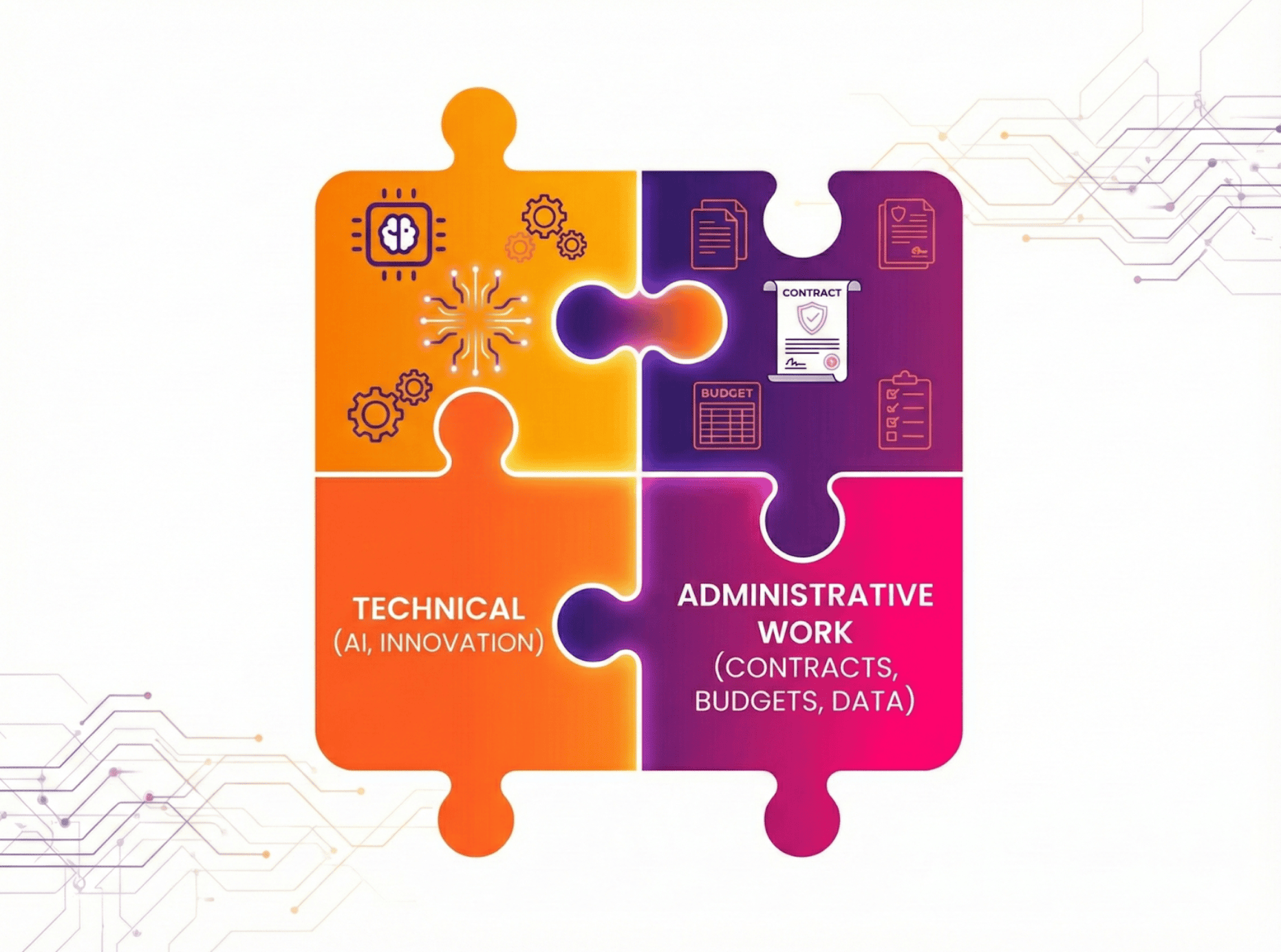
Generative AI’s strongest capabilities—synthesizing documents, reconciling data, managing structured coordination—match precisely to the administrative work that dominates clinical operations. The fit is immediate.
That’s good news. The work that too often slows down clinical research isn’t the science. It’s everything wrapped around the science: contracts, budgets, queries, regulatory documents, enrollment tracking.
Now we have a capability built for exactly that layer.
But knowing where to focus is only the start. The harder question is how—how do you move from experimenting with AI to actually transforming the work? This essay makes the case for administrative work as ground zero, then walks through what workflow transformation looks like when you get serious about it.
Why Administrative Work? Four Reasons.
1. It’s Low Risk
Let’s be clear about what we’re not talking about. We’re not talking about AI making clinical decisions. We’re not talking about safety reporting. We’re not talking about anything that directly touches patient care or regulatory submissions without human oversight.
Administrative work—contracts, budgets, queries, document preparation, data reconciliation—sits in a different category. Important. Time-consuming. Often the bottleneck.
The Risk Calculus
But errors here are correctable. They don’t put patients at risk. That matters when you’re asking people to trust a new way of working.
When I talk with site leaders about AI, the first concern is almost always risk. “What if it gets something wrong?” The honest answer: it will. So will your team. And working together, your team and AI will make fewer mistakes than if you rely on only one of them.
But for responsible AI, the question isn’t whether errors will happen. It’s whether the consequences are recoverable. Administrative work passes that test. A contract clause that needs revision isn’t a patient safety event.
You have time to catch mistakes, learn, and improve. Start here. Build confidence—yours, your team’s, your institution’s—before moving to higher-stakes applications.
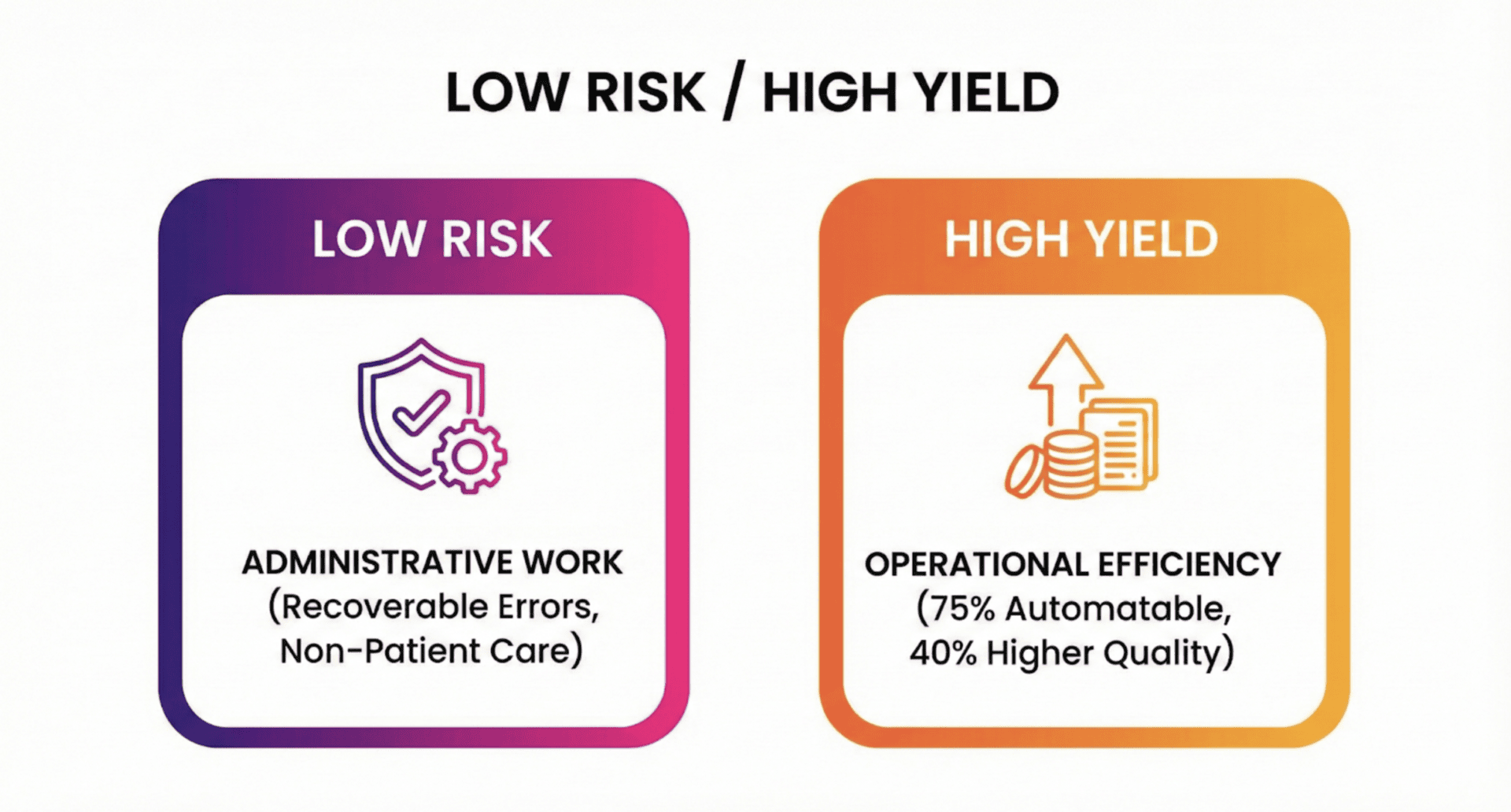
[For] responsible AI, the question isn’t whether errors will happen. It’s whether the consequences are recoverable. Administrative work passes that test. A contract clause that needs revision isn’t a patient safety event.
2. It’s High Yield
Administrative work isn’t just low risk. It’s where the volume lives—and where the efficacy data is most compelling.
Key Research & Data
- MIT’s “Project Iceberg”: Hidden administrative operations represent a massive $1.2 trillion in labor value.
- Penn Wharton: Roughly 75% of administrative tasks are AI-compatible.
- Harvard Business School & BCG: Knowledge workers using AI produced results 40% higher in quality than peers working without it.
This is the “grind” of clinical ops. But it’s not just about speed. That matters for clinical operations. We aren’t just looking to move contracts faster. We want accuracy in budgets, consistency in contract language, clarity in query responses. The data suggest that teams who work well with AI deliver both velocity and quality.
3. It Eases Pressure on Your Team
This isn’t only about efficiency. It’s about sustainability. Coordinators and CRAs are exhausted. Technology burden is a top complaint. System fragmentation is draining. The administrative load keeps growing.
The work that burns people out isn’t usually the clinical work—it’s everything around it. When I ask site leaders what their people complain about most, it’s rarely “the science is too hard.” It’s: “I spend half my day entering the same information in different places.” Also, and selfishly to our business, it’s also that “Contract redlines take forever.”
AI applied to administrative work addresses this directly. Not by eliminating jobs—by accelerating parts of jobs that nobody wants.
The “Novice” Advantage
Research from the National Bureau of Economic Research (NBER) found that when support staff used AI tools, productivity increased 14% on average—but for novice and lower-skilled workers, it jumped 34%.
Think about your newest coordinator. Think about ramp-up time for a new budget analyst. AI helps newer staff operate with the pattern recognition of veterans. It levels the playing field and reduces the burden on senior staff to oversee every detail.
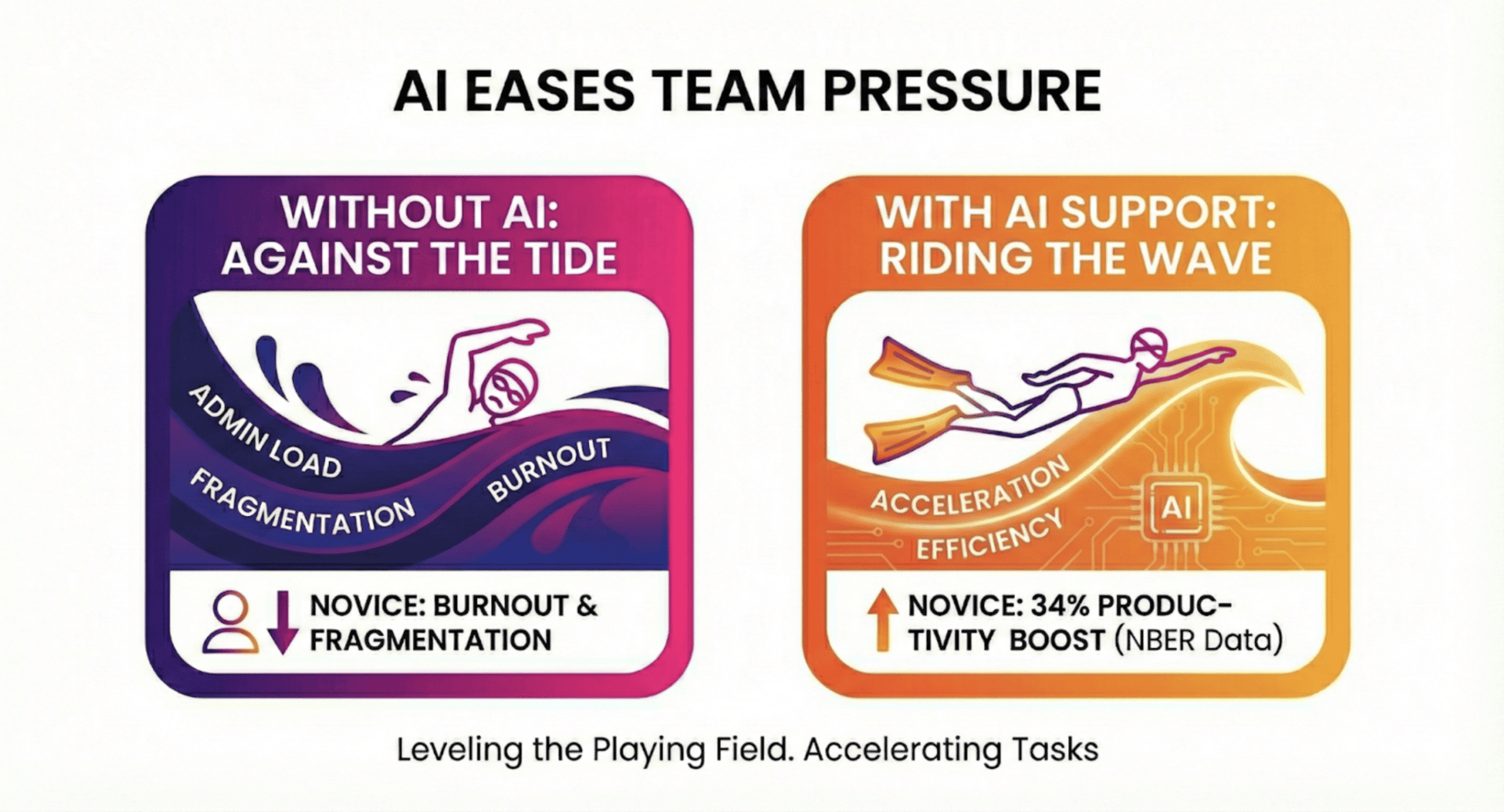
AI applied to administrative work addresses this directly. Not by eliminating jobs—by accelerating parts of jobs that nobody wants.
4. The Staffing Crisis Creates Permission
This is the part that doesn’t get said enough. For years, automation conversations in clinical research have been fraught. “Are you trying to replace us?” is a reasonable question from staff who’ve watched technology promises come and go.
The Staffing Crisis Changes the Calculus
When you can’t hire enough coordinators or administrators—when positions sit open for months, when your best people are burning out—the conversation shifts.
You’re not automating to cut headcount. You’re automating because you don’t have enough heads. That’s a permission structure.
Stanford research found that 69% of workers actively want AI to handle routine tasks so they can focus on higher-value work. Your team won’t be afraid of AI taking their job if they’re exhausted by work that feels like it should already be automated.
What Workflow Transformation Actually Looks Like
Most organizations start with Augmentation. The workflow stays the same, but individual steps get faster. Your coordinator still drafts the contract; AI helps with the first version. This is valuable, but can have limitations.
Transformation has the opportunity to be different. The workflow itself changes. Steps get eliminated, not just accelerated. Handoffs get reduced. The human role shifts from doing the work to validating and deciding.
McKinsey Insight: High performers—the roughly 6% of organizations seeing the most financial impact from AI—are nearly three times more likely to have fundamentally redesigned workflows as part of their AI implementations. (Source)
The gap isn’t tool access. Everyone has access. The gap is whether you’ve rethought how the work gets done.
A Concrete Example:
Traditional Contract Workflow
- Sponsor sends template
- Coordinator reviews against site requirements
- Coordinator drafts redlines
- Legal reviews
- Coordinator incorporates feedback
- Document sent to sponsor
- Sponsor responds with counter-redlines
- Repeat, often multiple times
- Final review and signature.
Transformed Contract Workflow
- Sponsor sends template
- AI analyzes against site playbook, flags deviations, generates recommended redlines
- Coordinator reviews AI output (focusing only on exceptions)
- Legal reviews only flagged high-risk items
- Document sent to sponsor
- AI analyzes counter-redlines, highlights changes
- Coordinator and legal address only substantive issues
- Final review and signature.
The difference isn’t speed at each step. It’s a different division of labor. Pattern-matching moves to AI. Ultimate judgment stays with people.
How to Map for Transformation
For each step in your workflow, ask four questions:
- Who touches this? Every handoff is a delay risk and an error risk.
- What’s the input? Structured (forms, templates) or unstructured (emails, conversations)?
- What’s the decision? Pattern-based (if X, then Y) or judgment-based (context, relationships)?
- What’s the output? Is there a clear definition of “done well”?
Look for opportunities where handoffs can be eliminated, structured inputs enable AI processing, and pattern-based decisions can be automated with human spot-checking. Protect human involvement where relationships matter, context is ambiguous, or judgment is genuinely required.
The 60/40 Rule
About 60% of most administrative workflows follow patterns. About 40% require genuine judgment. The ratio varies by workflow.
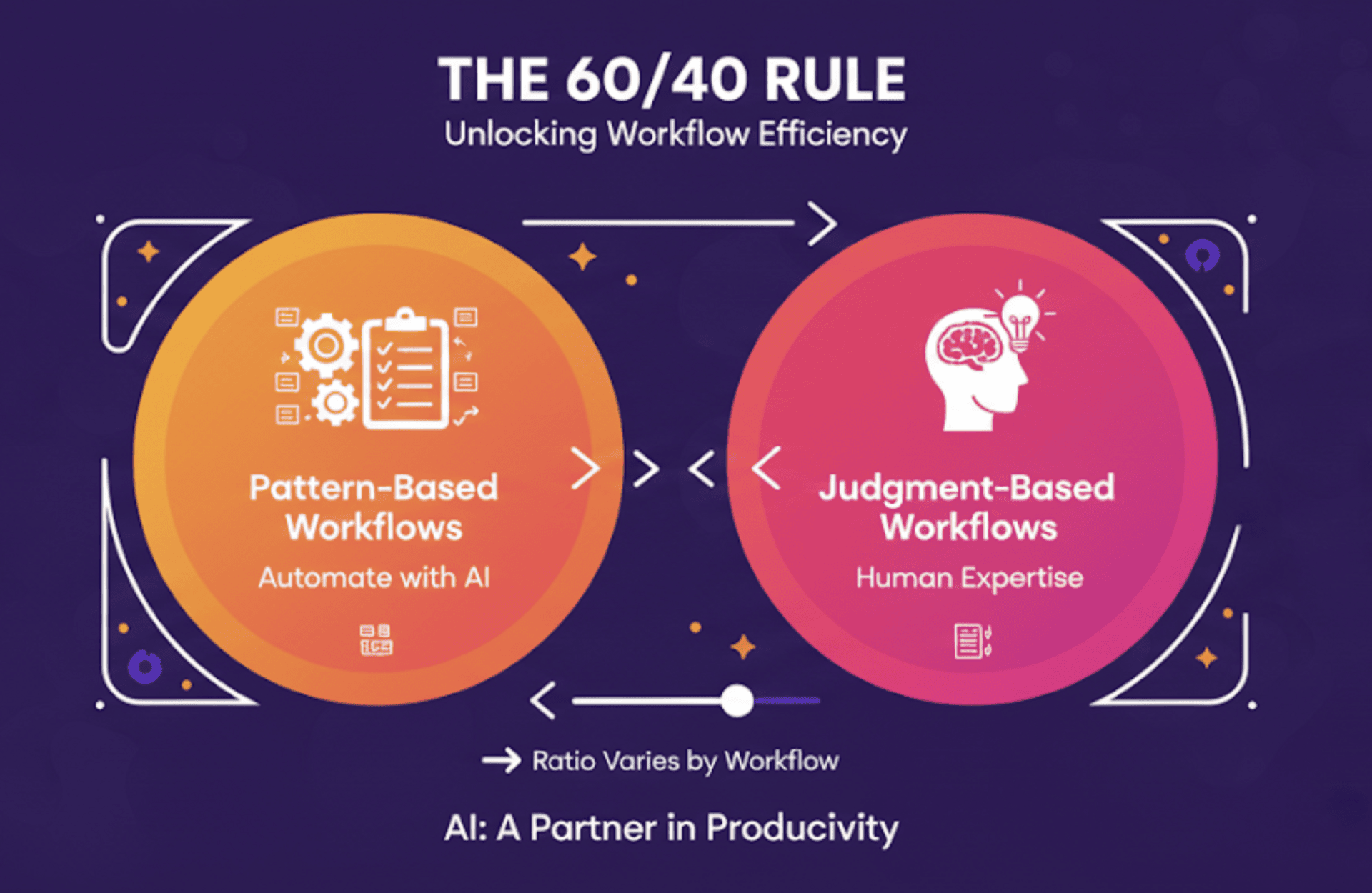
- Multi-round contract negotiation leans heavier on judgment. First round contract markups – identifying deviations from standards – is pattern work. Negotiating relationship trade-offs is judgment.
- Query management leans heavier on pattern. Categorizing types and drafting standard responses is pattern work. Managing escalations is judgment.
- Budget development sits in between. Pulling historical rates or identifying gaps between protocols and budgets is pattern work. Negotiation priorities and logic are judgment.
Map your key workflows explicitly. It clarifies where AI helps immediately, where it needs guardrails, and where humans stay in control.
What This Means for 2026
- Pick one or two administrative workflows. Choose where pain is highest and structure is clearest.
- Map them honestly. Involve the people who actually do the work—they know where the friction lives.
- Define “transformed.” If you can’t articulate the difference between current state and future state, you may not be ready to buy anything.
- Evaluate against burden reduction. Will this simplify or complicate?
Use the staffing crisis as your permission structure. You’re not replacing anyone. You’re making the team you have sustainable.
What’s Next
Everything in this essay keeps humans at the center of the loop. AI drafts, humans review. That’s changing.
Essay 3 addresses what happens when AI doesn’t just assist your workflows but begins to operate them—monitoring for triggers, executing routine steps, escalating only when human judgment is genuinely required.
That’s the shift from “human in the loop” to “human above the loop.”
It’s where roles change, governance becomes non-negotiable, and the question moves from “How do I use AI?” to “How do I design and oversee a system where AI and humans work together?”
That transition is coming faster than most expect. But you don’t get there without a foundation. The foundation is administrative work—transformed, not just augmented. Start here. Start now. Build the muscle.
Jim Wagner is CEO of The Contract Network, where AI is used responsibly under enterprise-grade security controls to help research sites and sponsors optimize clinical trial agreements and budgets. TCN’s AI implementation follows CHAI principles, maintains SOC 2 Type II compliance, and prohibits model training on customer data.